
Why Culture Determines Value Realization
Organizations that recognize culture as a strategic driver—not a post-close consideration—put themselves in the strongest position to realize the full value of every transaction.
Chad Klutts
7/22/20263 min read

Why Culture Determines Value Realization
Every acquisition begins with a promise. Whether it's accelerated growth, expanded capabilities, operational efficiencies, or access to new markets, every transaction is built around a deal thesis—a clear vision for how the combined organization will create value that neither company could achieve independently.
By the time a deal closes, that thesis has been thoroughly tested. Financial models have been refined, due diligence has been completed, risks have been assessed, and synergy targets have been established. Leadership teams leave the closing table confident in the opportunity ahead.
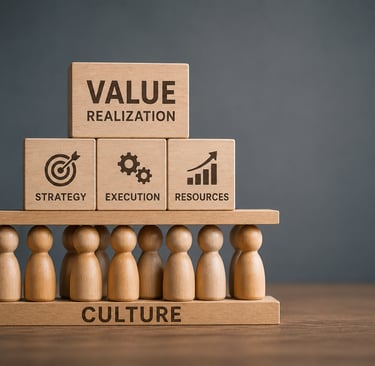
Yet despite months of planning and analysis, many acquisitions never deliver the value that justified the investment. It's tempting to assume the deal thesis was flawed. More often, the problem isn't the strategy. It's the execution. And execution is ultimately determined by culture.
Culture Is Not a "Soft" Issue
Culture is frequently treated as an employee engagement initiative—a consideration for Human Resources after the more pressing integration work has been completed. That perspective misses the role culture actually plays.
Culture shapes how people make decisions, solve problems, respond to uncertainty, and work together. During an integration, those behaviors influence every workstream, every milestone, and every strategic objective.
When trust is low, decisions slow.
When communication is inconsistent, alignment breaks down.
When employees remain loyal to legacy organizations rather than the future enterprise, collaboration suffers.
The consequences eventually appear as missed deadlines, delayed synergies, customer disruption, or the loss of key talent. They look like operational problems, but they often have cultural roots. Culture doesn't compete with execution...it enables execution.
Financial Models Don't Create Value
Every transaction begins with a financial model. Those models identify opportunities for revenue growth, cost reductions, operating efficiencies, and strategic expansion. They establish the economic rationale for the acquisition. What they don't capture is how those outcomes are achieved.
Revenue synergies don't materialize because they appear in an investment committee presentation. Cost savings aren't realized because they exist in a spreadsheet. Value is created when leaders make difficult decisions, employees adopt new ways of working, functional teams collaborate across legacy organizations, and customers experience a seamless transition.
Every synergy ultimately depends on people changing how they work. Financial models estimate value....people create it.
Execution Lives in the Organization
Organizations often approach integration as a collection of independent workstreams—Finance, HR, IT, Operations, Commercial, Legal, and Communications. While each function has its own objectives, none operates in isolation.
A technology implementation depends on business adoption.
A new operating model depends on leadership alignment.
Commercial integration depends on trust between sales teams.
Process standardization depends on employees embracing change.
The common denominator isn't project management. It's culture. Culture becomes the operating system that determines whether every workstream succeeds or struggles.
Stop Treating Culture as a Communications Plan
Many organizations acknowledge culture during integration. Far fewer manage it with the same rigor they apply to governance, synergy tracking, or financial reporting. Too often, culture is reduced to town halls, employee surveys, or communication campaigns. Those activities have value, but they aren't a culture strategy.
Successful integrations begin by understanding the strengths each organization brings to the transaction. They identify where cultures naturally align, where friction is likely to emerge, and which behaviors are essential to protecting the deal thesis. Leadership teams then reinforce those behaviors through consistent decisions, clear accountability, and visible commitment.
Culture isn't something that develops on its own....like every other critical aspect of integration, it requires intentional leadership.
Alignment Is More Important Than Uniformity
One of the most common misconceptions about integration is that success requires one organization to adopt the culture of the other. In reality, the strongest integrations rarely erase the identity that made either company successful. The objective isn't uniformity, it's alignment.
Employees don't need to think alike. They need to understand where the organization is going, how decisions will be made, and what success looks like. When that happens, execution accelerates.
When execution accelerates, value realization follows.
The Real Measure of Success
Organizations often evaluate integrations by whether milestones were completed on time or projects stayed on budget. Those metrics matter, but they are not the ultimate measure of success. The question that matters most is whether the organization delivered the value envisioned when the transaction was approved.
That requires more than governance. More than project plans. More than synergy tracking. It requires an organization capable of executing together.
Every acquisition begins with a deal thesis. Every transaction is judged by the value it creates. The bridge between those two moments isn't simply integration planning...it's people.
Organizations that recognize culture as a strategic driver—not a post-close consideration—put themselves in the strongest position to realize the full value of every transaction.
Bleue Line M&A Integration
The line that connects integration vision to execution.
Home - Services - Experience - About - Contact
© 2026 Bleue Line Advisors
Integration. Separation. Transformation.